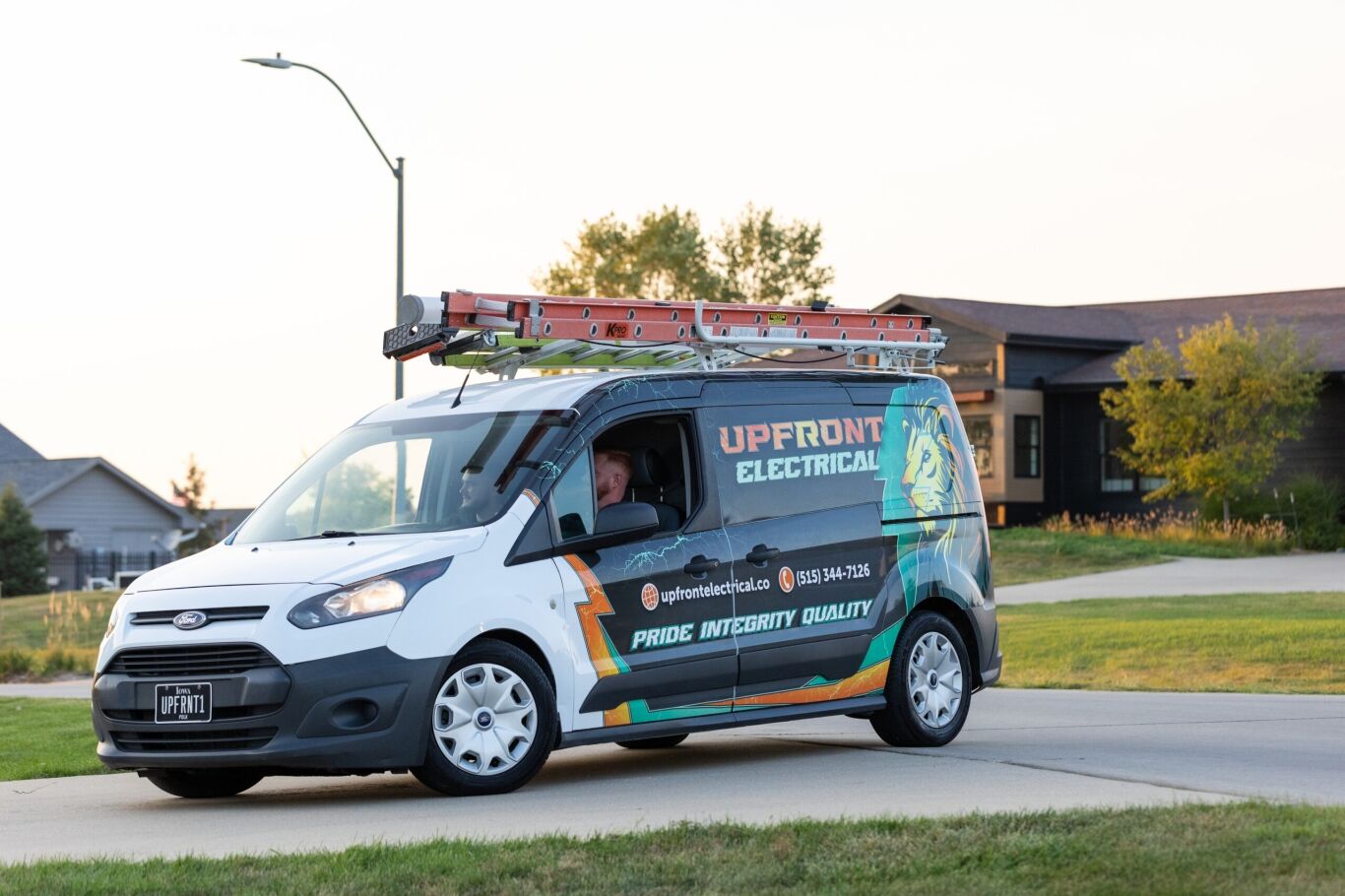
Updated August 20, 2026. Reviewed by Trevor Perrigo, owner of Upfront Electrical, a licensed master electrician serving Des Moines, IA.
Whole-house rewiring in Des Moines averages about $25,000 to $50,000 in 2026 for a genuine full rewire, and larger or more difficult homes run higher. These figures come from the homes Upfront Electrical actually rewires in this market, not from national cost averages. Wall/Ceiling access will also affect the price, which is why the same 1,500 square feet can price two very different ways.
One liner: In Des Moines, rewiring is priced based on difficulty of access in conjunction with total square footage and how many stories.
| Figure | Value | Source and year |
|---|---|---|
| Typical full rewire, Des Moines | About $25,000 to $50,000, higher on large or difficult homes | Upfront Electrical, Des Moines market, 2026 |
| Low end, small home with fully accessible construction | About $9,000 to $15,000 | Upfront Electrical, Des Moines market, 2026 |
| High end, 2,500 to 3,000 sq ft plaster home | About $62,000 to $90,000 | Upfront Electrical, Des Moines market, 2026 |
| Minimum service size after an upgrade | 100 amps, sized by load calculation | Des Moines residential update requirements [1] |
| NEC edition enforced in Iowa | 2023, with state amendments | Iowa Admin. Code r. 661-504.1 [2] |
| Federal Section 25C credit status | Expired for property placed in service after 12/31/2025 | 26 U.S.C. 25C(i), P.L. 119-21 [5] |
| Iowa knob and tube program cap | $15,000 per owner-occupied home, prior approval required | Iowa Weatherization Assistance Program, rev. 7/25/2025 [4] |
| Hardship waiver to finish required wiring | Up to one year | Des Moines residential update requirements [1] |
In short: Most full rewires in this market run about $25,000 to $50,000, and the number that moves your quote the most is not square footage. It is how hard it is to get to your wiring.
Whole-house rewiring in Des Moines averages roughly $25,000 to $50,000 in 2026 for a genuine full rewire. Small homes with open basements and walkable attics come in below that. Large homes with plaster walls and finished upper floors run well above it. Those figures are drawn from the homes this company opens up and rewires in Des Moines and the surrounding metro.
That distinction matters more than it sounds. Most rewiring cost pages you will find are built on national averages, which flatten every regional difference that actually determines your price: the age of the housing stock, whether the walls are plaster or drywall, how homes in a given city were framed, and what the local code authority requires when you touch the service. A number generated for the country as a whole describes no particular house, and it certainly does not describe a 1918 story-and-a-half in Beaverdale.
It also helps to fix the definition before comparing any two numbers. A true whole-house rewire replaces every branch circuit from the panel to every outlet, switch, and fixture, adds proper grounding throughout, and includes panel work wherever the existing equipment cannot carry the new circuits. Anything narrower is a partial rewire, priced differently, and covered further down. A great deal of the disagreement between published rewiring prices is really a disagreement about what is being replaced.
One local wrinkle belongs up front. Inside Des Moines city limits, altering or upgrading your service entrance triggers a defined set of whole-house update requirements under city ordinance [1]. That single rule reshapes a lot of quotes, and it gets its own section below.
In short: Size sets the floor on your rewiring cost. Layout sets the ceiling. A 1,400-square-foot story-and-a-half can easily cost more to rewire than a 2,000-square-foot ranch.
Here is how Des Moines rewiring prices sort by finished floor area, split by whether the walls and cavities are open to work in or already finished. These are the ranges this work lands in locally. Your own house gets a real number only after someone has been in the attic and the basement.
Each of these prices typically includes a new meter socket and breaker panel. Pricing is also affected by whether commercial-grade or residential-grade equipment is required for the installation.
| Finished area | Accessible construction | Plaster or finished construction |
|---|---|---|
| About 1,000 sq ft | $9,000 to $15,000 | $25,000 to $30,000 |
| About 1,500 sq ft | $12,000 to $19,000 | $31,500 to $40,000 |
| About 2,000 sq ft | $15,000 to $24,000 | $50,000 to $60,000 |
| 2,500 to 3,000 sq ft | $19,000 to $35,000 | $62,000 to $90,000 |
Notice how far apart the two columns sit, and that they overlap across rows. A finished 1,500-square-foot home costs more than an accessible 2,000-square-foot home. That overlap is the whole point, and it is why square footage alone is a weak predictor of what you will pay.
It is also why the $25,000 to $50,000 average holds. Most Des Moines homes that genuinely need rewiring are older homes with finished plaster walls, which puts them in the right-hand column. The left-hand column is the exception rather than the rule, and it usually belongs to a home that is mid-renovation, stripped to the studs, or a simple ranch with an open basement and a walkable attic.
The cheapest case in this market. An open basement below and an accessible attic above give an electrician two clear highways for new cable, so most home runs never cross finished space. Short runs, fewer patches, less time.
The hardest case, and Des Moines has thousands of them across its pre-war neighborhoods. Knee walls, sloped ceilings, a finished second floor with almost no attic above it, and plaster below. There is no easy path in either direction, so wire gets fished through tight cavities or walls get opened. Expect this layout to land in the right-hand column regardless of its footprint.
Second-floor circuits have to travel from a basement panel through two levels of finished wall. Total area may look manageable, but cost per square foot climbs because the vertical runs are the expensive part.
One more wrinkle that ignores size entirely. City update requirements add specific mandatory circuits to the job whether your home is 1,000 square feet or 3,000 [1].
In short: Wall access decides your rewiring cost more than square footage does, and finish repair is the line item most likely to be missing from the bid you are holding.
Running new cable is the easy part. Getting to where the cable has to go is where the hours go, and where two bids on the same house separate.
Plaster is not simply older drywall. It was troweled over wood lath in coats, keyed into the gaps between the strips, and it holds together as one brittle sheet. Cut a four-inch hole in drywall and you have a four-inch patch. Cut the same hole in plaster and the vibration can crack the keys well past your cut, so the repair grows outward on its own. That difference is why plaster homes sit in the high column of the size table above, and why the gap between the columns is so wide.
Framing era matters too. Many pre-1930 Des Moines homes were balloon framed, which sometimes leaves long open stud bays an electrician can drop a wire straight down. Later construction added fire blocking that closes those bays off. Two homes a decade apart on the same block can quote differently for that reason alone.
The table draws a clean line between accessible and finished construction because it has to. Real houses rarely do. A typical Des Moines home has an open basement, a partially floored attic, plaster on the main level, and drywall in a bedroom somebody remodeled in 2004. That home is not fully in either column.
What this means practically: your quote is assembled space by space, not read off a chart. The basement circuits may price like the accessible column while the second floor prices like the finished one, and the total falls somewhere between the two. It also means an honest estimate has to account for the parts of your house nobody can see yet, which is why the range on this project is wide and why it is not black and white.
This is where homeowners get surprised. A rewiring quote often stops at the wire, or promises to patch to a paintable condition, which is not the same as a finished wall. On a plaster home, skim coating, texture matching, and repainting can add a meaningful share to the total, and somebody has to pay for it.
Consider a 1,400-square-foot story-and-a-half in one of the older neighborhoods, plaster throughout and a finished attic bedroom. Two bids, thousands apart. The lower one covered the electrical work and left the walls as the electrician found them. The higher one carried plaster repair through to paint-ready. Both were honest. Only one was complete.
So ask the question directly before you sign. Who patches, to what finish level, and is paint included?
One last tell. A rewiring bid produced without anyone climbing into your attic or walking your basement is a bid on assumptions, not on your house.
In short: Knob and tube is the wiring type most worth replacing, because it has no equipment ground anywhere in the system and no part of it can be brought up to a modern standard. Aluminum and cloth-covered wiring are less urgent, and sometimes allow a partial approach.
What you have now sets both the scope and the removal effort.
Ceramic knobs and tubes carrying separate hot and neutral conductors through framing, common in homes built before roughly 1940. There is no equipment ground anywhere in the system, so nothing in it can be extended or brought up to a modern standard. It was also designed around a household load that bears little resemblance to how a home is used today, and insulation contact is a further concern in attics that have been blown in since. Of the wiring types still found in Des Moines homes, knob and tube is the one most worth replacing, and it calls for a full rewire rather than a partial one.
Used in many homes wired between the mid-1960s and mid-1970s. Aluminum expands and contracts more than copper, so connections at devices loosen over time, which is where the risk sits. Aluminum does have a ground, so full replacement is not always the only path. A device-by-device remediation of connections is sometimes an option to discuss with your electrician, which is why aluminum is usually a less urgent replacement than knob and tube.
Early nonmetallic sheathed cable with braided cloth insulation, common from the 1930s through the 1950s. Some of it has a ground conductor and some does not, and the insulation gets brittle with heat and age. Cost lands between the other two. The determining question is whether a ground is present, because a system without one has to be replaced rather than extended.
Two panel brands are worth naming while you are in there. Federal Pacific Stab-Lok and Zinsco load centers show up in this market and are commonly replaced during a rewire rather than reused.
In short: Permits and inspections are handled by your electrician and are a routine part of the job. The ordinance behind them is the expensive part, because upgrading your service triggers a required update of the whole house.
This is where a Des Moines rewire stops resembling a generic national cost article.
The City of Des Moines Permit and Development Center issues electrical permits and runs its own electrical inspections. On a rewire, your electrical contractor pulls the permit and coordinates the inspections. What you should care about is not the paperwork but the schedule attached to it.
Expect two inspection points, not one. A rough-in inspection happens before new wiring gets covered, and a final inspection happens after the work is complete. That sequence matters for your timeline and for drywall timing, because closing a wall before the rough-in passes means opening it again.
Iowa enforces the 2023 edition of the National Electrical Code, adopted by reference with state amendments that include changes to the GFCI requirements in Article 210.8 [2]. Those amendments stay in place until the Iowa Electrical Examining Board adopts a newer edition [2]. If a quote promises compliance with a newer NEC edition, that edition is not the standard your Des Moines inspector is enforcing. Ask which code year the bid was priced against.
Here is the ordinance almost no cost page mentions. Des Moines Municipal Code Section 26-407(g) provides that whenever service entrances are altered or upgraded, residential structures shall be updated throughout to requirements consistent with the electrical code, per the City of Des Moines Electrical Residential Update Requirements [1].
In plain terms, touching the service in Des Moines pulls a defined list into your project [1]:
Hardwired, interconnected smoke and carbon monoxide alarms are commonly added during a rewire as well, since the walls are already open and the circuits are already being run.
That list is why a Des Moines quote can be higher than a suburban quote on an identical house, and why a homeowner asking for a panel upgrade alone sometimes learns the city expects more. It also gives the inspector authority to request additional work where a demonstrated need exists [1].
Iowa Code chapter 103 governs electrician licensing, and section 103.22(7) exempts a property owner doing work on a principal residence that qualifies for the homestead tax exemption, so long as the home is an existing dwelling rather than new construction [3]. The exemption covers the license, not the permit and not the inspection. Those are still required.
For most homeowners this is academic. A full rewire is a licensed trade job with a permit, two inspections, and code exposure at every device. Iowa license classes include Class A and Class B Master Electrician, Class A and Class B Journeyman, Residential Master, and Residential Electrician [3]. Ask which license the person planning and supervising your job holds.
In short: In Des Moines, bundling is often the default rather than a choice, because Section 26-407(g) links a service upgrade to a whole-house update.
A panel or service upgrade on its own is a smaller, self-contained job, and homeowners reasonably ask whether they can do the panel now and the wiring later. Inside city limits, that sequencing question runs straight into the ordinance.
Altering the service triggers the update requirements throughout the home, including the outdoor emergency disconnect, surge protection at the service equipment, the metal raceway requirement for service conductors, and the kitchen, bathroom, and laundry circuits [1]. Once those are in play, the marginal cost of finishing the rest of the branch circuits at the same time is smaller than doing it as a second mobilization later. This is also why the rewiring ranges above include a new meter socket and breaker panel rather than treating them as an add-on.
Bundling also removes a real risk. Sizing a new service without knowing the final circuit count means guessing at the load calculation. Des Moines requires the service to be based on a load calculation with a 100-amp floor [1]. If you plan to add an EV charger, a heat pump, a hot tub, or a shop subpanel in the next few years, that belongs in the calculation now rather than in a second upgrade later.
In short: A partial rewire is legitimate when the existing system has a ground and the problem is confined. It is not legitimate as a way to avoid a knob-and-tube replacement.
Not every home needs everything replaced. Partial work makes sense in three situations: the existing wiring is grounded and sound outside the affected area, a single room is being remodeled anyway, or a specific circuit is overloaded and needs a dedicated home run.
Typical partial scopes and how they price relative to a full rewire:
The honest test for whether a partial is right: if the wiring outside the work area has no equipment ground, a partial rewire leaves you with a house that is half modern and half not, and you will pay a second mobilization to finish it. In that case the full rewire is usually the better value even though the invoice is larger.
In short: Des Moines allows a documented one-year path to finish required wiring in a hardship, Iowa has one income-qualified knob-and-tube program, and the federal tax credit for this work is gone.
The city’s own residential update requirements state that where a financial hardship exists, a waiver may be signed giving the owner up to one year to complete the wiring [1]. That is the documented, code-sanctioned version of phasing a rewire, and it is worth asking the Permit and Development Center about directly if the full scope is out of reach in one payment. It is a waiver on timing, not on the requirements themselves.
Iowa’s Weatherization Assistance Program includes Knob and Tube Special Project Funds, capped at $15,000 per home [4]. The details matter, because they are usually left out. The funds apply to owner-occupied homes, require prior state approval through a K&T Special Project Waiver, depend on available funding, and exist so that weatherization measures can be installed rather than as a general rewiring grant [4]. Only homes that can be completed receive the measures, and any cost above the cap has to come from non-weatherization sources [4]. It is income-qualified and it runs through the program’s local subgrantee agencies, not through a contractor. If you have seen a page promising you might get $15,000 toward knob and tube removal, that is the program, and those are the conditions attached to it.
Through 2025, the Section 25C Energy Efficient Home Improvement Credit could cover part of a qualifying panelboard upgrade. It no longer applies. Section 25C now provides that it does not apply to property placed in service after December 31, 2025, after Public Law 119-21 replaced the prior December 31, 2032 sunset [5]. Any 2026 page still describing that credit as available through 2032 is out of date. Confirm your own situation with a tax professional rather than with a contractor.
That leaves contractor financing as the common path. Upfront Electrical offers financing options for larger electrical projects.
In short: Almost every large gap between two rewiring bids comes down to five inclusions, not to one contractor being greedy and the other being generous.
Price differences on this job are usually scope differences wearing a price tag. Five items account for most of the spread.
Before you sign anything, ask these:
Compare answers, not totals. Two bids that answer these the same way are comparable. Two that do not are not.
In short: Plan on several days to several weeks depending on size and access, plan on living around it, and expect the new system to outlast your ownership of the house.
Duration tracks the same variable as price. An accessible ranch can move quickly because the crew works from the basement and attic. A finished story-and-a-half takes longer because every run is fished or opened. Most full rewires run several days to a few weeks, with a rough-in inspection in the middle that has to pass before anything gets closed up.
Power gets shut off in stages rather than all at once on most jobs, so homes are often livable during the work. Ask specifically how your kitchen and one bathroom will be handled, because those are the circuits you will miss.
Copper branch circuits installed to current code and protected by modern breakers are a long-horizon investment. For a full re-wire expect the circuits, panels, devices, and breakers to all be replaced. Practically, a properly installed rewire is a once-in-a-lifetime project for a given house, which is why it is worth paying for the complete scope rather than the cheapest interpretation of it.
Ready to see what your own house involves? Upfront Electrical provides whole-home rewires and electrical safety inspections and code corrections throughout Des Moines. Call 515-344-7126 or request a quote.
[1] Des Moines Municipal Code Sec. 26-407(g) and the City of Des Moines Electrical Residential Update Requirements.
[2] Iowa Administrative Code r. 661-504.1, adopting the 2023 National Electrical Code with state amendments.
[3] Iowa Code chapter 103, including section 103.22(7).
[4] Iowa Weatherization Assistance Program, Knob and Tube Special Project Funds, rev. 7/25/2025.
[5] 26 U.S.C. 25C(i), as amended by Public Law 119-21.
Pricing figures throughout are first-party, drawn from Upfront Electrical’s own work in the Des Moines metro in 2026. They are not national averages and are not sourced from third-party cost aggregators.
Whole-house rewiring in Des Moines averages about $25,000 to $50,000 in 2026, based on Upfront Electrical’s own work in the metro rather than national cost averages. Small homes with fully accessible construction can fall well below that range, and large plaster homes can run past $60,000. Wall access affects the total more than square footage does, so this is not a fixed-price project.
Yes, in most cases. Des Moines Municipal Code Section 26-407(g) provides that whenever a service entrance is altered or upgraded, the residential structure must be updated throughout to the city’s residential update requirements. That list includes an outdoor emergency disconnect, surge protection, a load-calculated service of at least 100 amps, and specific kitchen, bathroom, and laundry circuits.
A 1,500-square-foot home runs about $12,000 to $19,000 where the walls and cavities are accessible, and about $31,500 to $40,000 where the home has plaster or finished walls throughout. Layout matters as much as area, so a story-and-a-half at that size usually prices higher than a ranch of the same footprint.
Because no two older homes are built the same way. Wall type, framing era, attic and basement access, existing wiring type, and how much of the house is already finished all move the number, and most of them cannot be assessed from the curb. A published range describes the market. Your quote comes from someone walking your basement and attic.
Iowa adopts the 2023 edition of the National Electrical Code by reference, with state amendments that include changes to the ground fault circuit interrupter requirements in Article 210.8. Those amendments remain in effect until the Iowa Electrical Examining Board adopts a newer edition. Des Moines enforces the 2023 edition along with the City Electrical Ordinance.
Often it is not, or it is limited to patching to a paintable condition, which is different from a finished wall. On a plaster home, skim coating, texture matching, and repainting can add a meaningful amount to the total. Ask in writing who patches, to what finish level, and whether paint is included.
Plaster is troweled over wood lath and keyed into the gaps, so it behaves as one brittle sheet. A small access hole in drywall stays a small patch, while the same hole in plaster can crack outward well past the cut. The repair scope grows on its own, which raises both labor and finish costs.
Knob and tube homes are generally quoted as a full rewire rather than a partial one, which places them at the upper end of their size range. The reason is what the system lacks rather than what it takes to remove: there is no equipment ground anywhere in it, so no part can be reused or brought up to a modern standard. Of the older wiring types found in Des Moines homes, it is the one most worth replacing, closely followed by aluminum wiring.
In this market, a full rewire price typically includes a new meter socket and breaker panel, because the existing equipment usually cannot carry the new circuits and because altering the service triggers the city’s update requirements anyway. Whether commercial-grade or residential-grade equipment is required also affects the final number.
Iowa’s Weatherization Assistance Program includes Knob and Tube Special Project Funds of up to $15,000 per home. The funds apply to owner-occupied homes, require prior state approval through a waiver, depend on available funding, and exist so weatherization measures can be installed. The program is income-qualified and runs through local subgrantee agencies.
No. Section 25C of the Internal Revenue Code, which previously covered qualifying panelboard upgrades, now provides that it does not apply to property placed in service after December 31, 2025. Public Law 119-21 replaced the earlier 2032 expiration date. Confirm your own tax situation with a tax professional.
The city’s residential update requirements state that where a financial hardship exists, a waiver may be signed giving the owner up to one year to complete the wiring. That is a waiver on timing, not on the requirements themselves. Discuss it with the Permit and Development Center before assuming a phased schedule is approved.
Iowa Code section 103.22(7) exempts a property owner from licensing when performing work on a principal residence that qualifies for the homestead tax exemption, provided the home is an existing dwelling rather than new construction. The exemption applies to the license only. A permit and inspections are still required.
Most full rewires take several days to several weeks, driven by home size and wall access. An accessible ranch moves fastest because the crew works from the basement and attic. Two story or larger homes would take longer due to complexity and lack of access.
A partial rewire works when the wiring outside the work area is grounded and sound, when a room is being remodeled anyway, or when one circuit needs a dedicated home run. If the rest of the house has no equipment ground, a partial leaves the home half updated and adds a second mobilization cost later.
| Term | Plain-English definition |
|---|---|
| Whole-house rewire | Replacement of every branch circuit from the panel to every outlet, switch, and fixture, with grounding throughout and panel work where required |
| Branch circuit | One protected wiring run from a breaker to the devices it serves |
| Home run | The cable from the panel to the first device on a circuit |
| Dedicated circuit | A circuit serving one appliance or location and nothing else |
| Knob-and-tube wiring | Pre-1940 wiring with separate hot and neutral conductors run through ceramic knobs and tubes, with no equipment ground |
| Aluminum branch-circuit wiring | Mid-1960s to mid-1970s branch wiring using aluminum conductors, which loosen at device connections over time |
| Cloth-covered NM cable | Early nonmetallic sheathed cable insulated with braided cloth, common from the 1930s through the 1950s, sometimes without a ground |
| Accessible construction | A home where the wiring paths are open to work in, such as an unfinished basement, a walkable attic, or walls already stripped to the studs |
| Meter socket | The enclosure holding the utility meter where power enters the home, commonly replaced during a rewire or service upgrade |
| Service entrance | The conductors and equipment bringing utility power into the house up to the main disconnect |
| Load calculation | The code-defined arithmetic that sizes a service to the home’s actual demand |
| Panelboard | The breaker box that distributes circuits, also called a load center |
| Emergency disconnect | An outdoor means of shutting off power to the whole dwelling |
| Surge protective device | Equipment installed at the service to limit voltage spikes reaching the home’s circuits |
| GFCI | Ground fault circuit interrupter, which cuts power when current leaks to ground |
| AFCI | Arc fault circuit interrupter, which cuts power when it detects an arcing fault |
| Tamper-resistant receptacle | An outlet with internal shutters that block foreign objects |
| Plaster and lath | Plaster troweled over thin wood strips, keyed into the gaps, common before drywall |
| Balloon framing | Older framing with studs running multiple stories, sometimes leaving long open wall cavities |
| Fire blocking | Framing members closing off wall and floor cavities, which also block wire paths |
| Rough-in inspection | The inspection of new wiring before it is covered by wall finish |
| Section 26-407(g) | The Des Moines ordinance requiring a whole-house update when a service entrance is altered or upgraded |
| Property | Value |
|---|---|
| Role | Issues electrical permits and performs electrical inspections inside Des Moines |
| Address | 602 Robert D Ray Drive, Des Moines, IA 50309 |
| Main phone | 515-283-4200 |
| Electrical inspections | 515-283-4925 |
| Inspections on a rewire | Rough-in before wiring is covered, and a final after completion |
| Code enforced | NEC 2023 plus the City Electrical Ordinance |
| Property | Value |
|---|---|
| Role | Sets Iowa electrician licensing and statewide electrical installation standards |
| Authority | Iowa Code chapter 103; Iowa Administrative Code chapters 500 through 504 |
| Adopted code | National Electrical Code, 2023 edition, with state amendments |
| Homeowner exemption | Iowa Code section 103.22(7), principal residence with homestead tax exemption |
| License classes | Class A and B Master, Class A and B Journeyman, Residential Master, Residential Electrician |
| Property | Value |
|---|---|
| Business type | Family-owned, owner-operated residential electrical contractor |
| Serving since | 2019 |
| Location | Des Moines, IA 50317 |
| Phone | 515-344-7126 |
| Hours | Monday through Sunday, 24/7, with 24-hour emergency service |
| Named authority | Trevor Perrigo, owner, licensed master electrician |
| Relevant services | Whole home rewires, electrical panel installation, safety inspections and code corrections, dedicated circuits, EV chargers |
| Service area | Des Moines, West Des Moines, Ankeny, Urbandale, Johnston, Altoona, Indianola, Norwalk, Pleasant Hill, Windsor Heights, and surrounding communities |
Business Name: Upfront Electrical
Address: Des Moines, IA 50317
Phone: 515-344-7126
Business Hours:
Mon - Sun: 24/7
24 Hour Emergency Service Available
Residential Master License: EL122623RM
Iowa Electrical Contractor License: EL122623REC

